STROKE-BY-STROKE HANDWRITING RECOGNITION
Learn to write Japanese hiragana and katakana by hand
Stroke by stroke — with handwriting recognition that actually tells you why a character is wrong. Then remember what you wrote, and read it.

Fude is an iOS app for learning to write Japanese hiragana and katakana by hand. You write each character with your finger, and Fude checks your writing stroke by stroke — not just whether the final shape looks right, but whether each stroke was drawn correctly. What you can write, you then learn to remember and to read.
HOW IT WORKS
It checks six things, for every character.
Many kana apps focus on recognition exercises or guided tracing. Fude focuses on what determines whether a learner can actually write: the structure and movement of every stroke.
It never validates an incomplete character.
Following authentic Japanese stroke order.
So look-alike characters can't be confused.
Matching the real curves of each stroke.
The relative size of each stroke.
A straight line drawn where a curve belongs is caught.
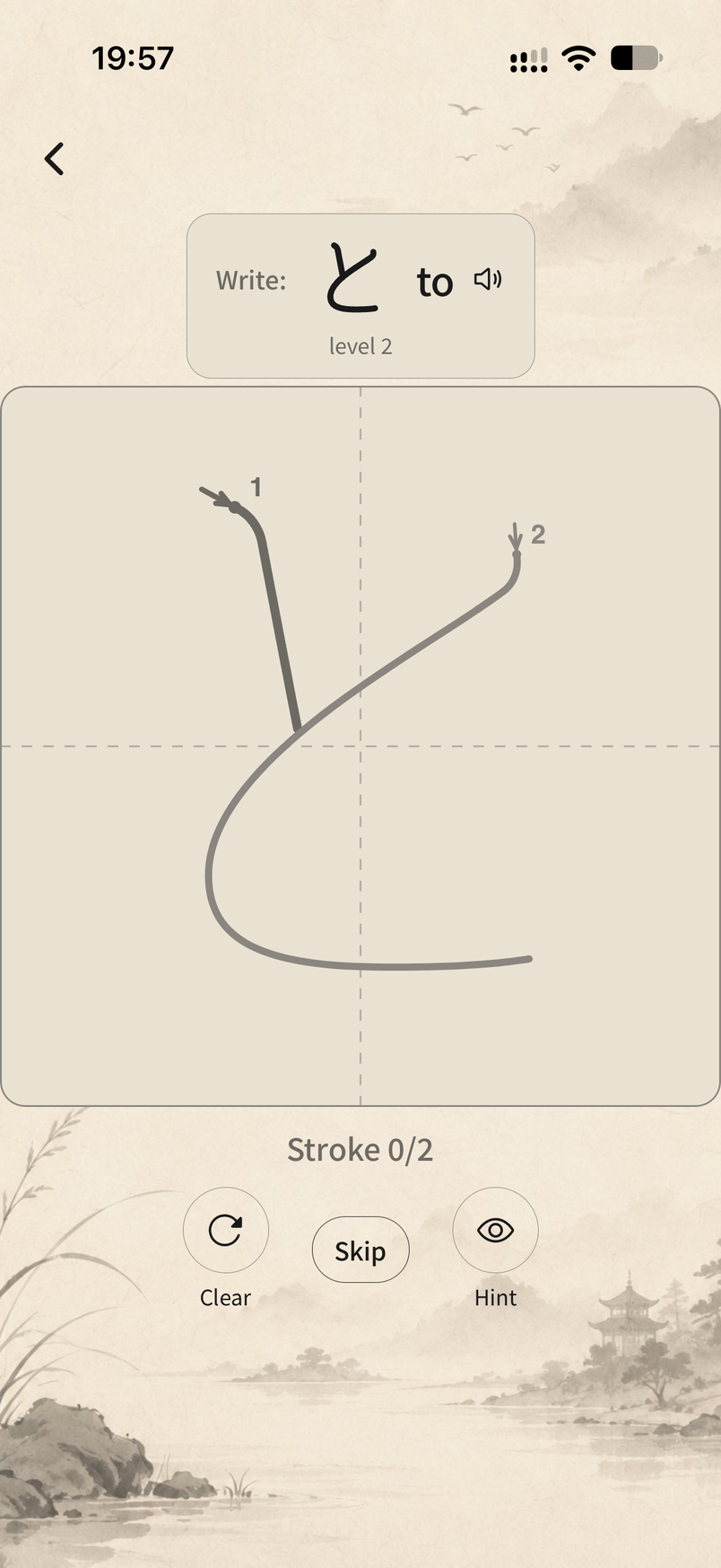
When a character is wrong, Fude tells you why — for example, "stroke 2 goes the wrong way" or "stroke 3 should be curved, not straight" — instead of silently refusing it.
BUILT TO MAKE WRITING STICK
Active recall, not passive tracing.
Fude uses active recall and spaced repetition: the guide fades as you improve until you write from memory, and characters you've learned come back for review at the right time. Practice rounds then check that you can read what you can write.
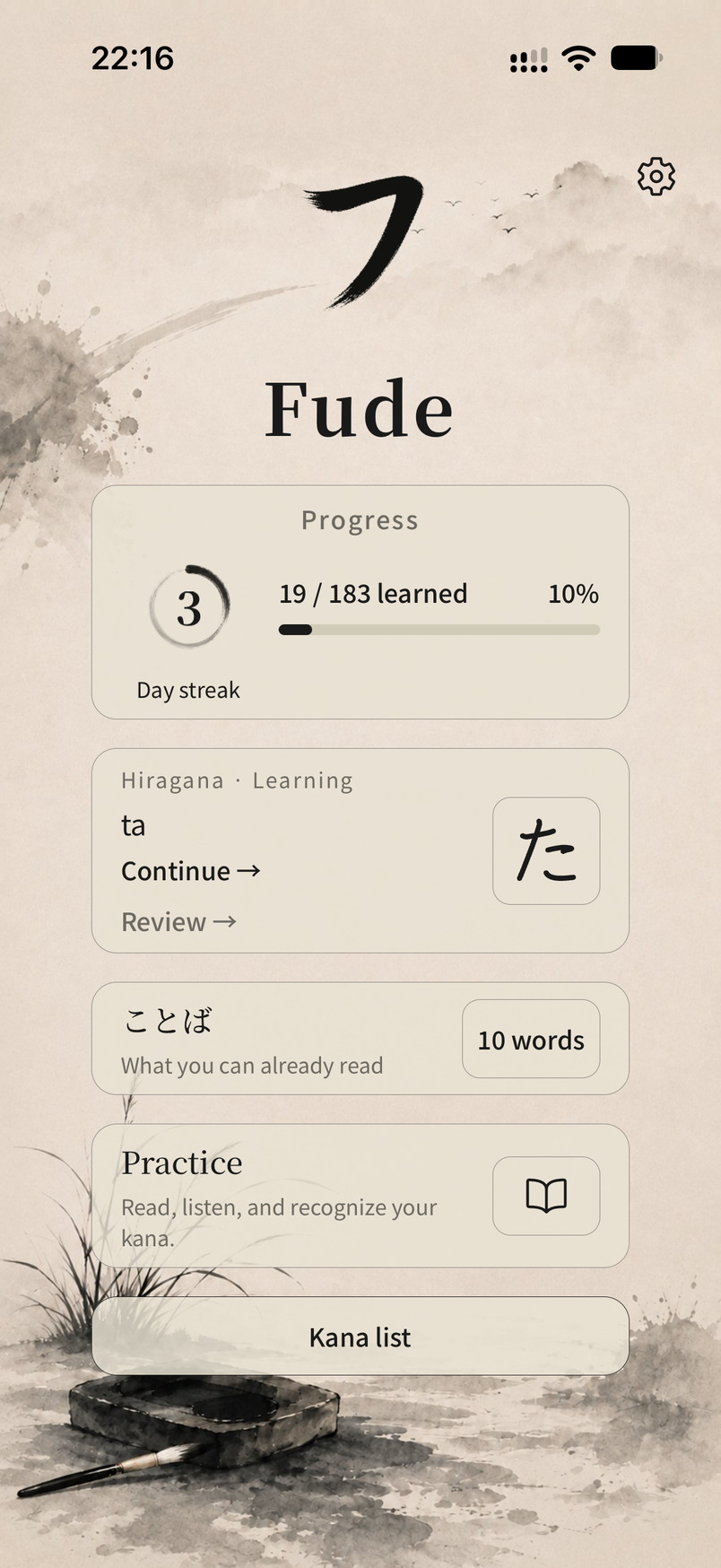
One next step, always ready
Home shows your progress across the 183 forms and your day streak, with a single action: Continue, Learn next or Review.
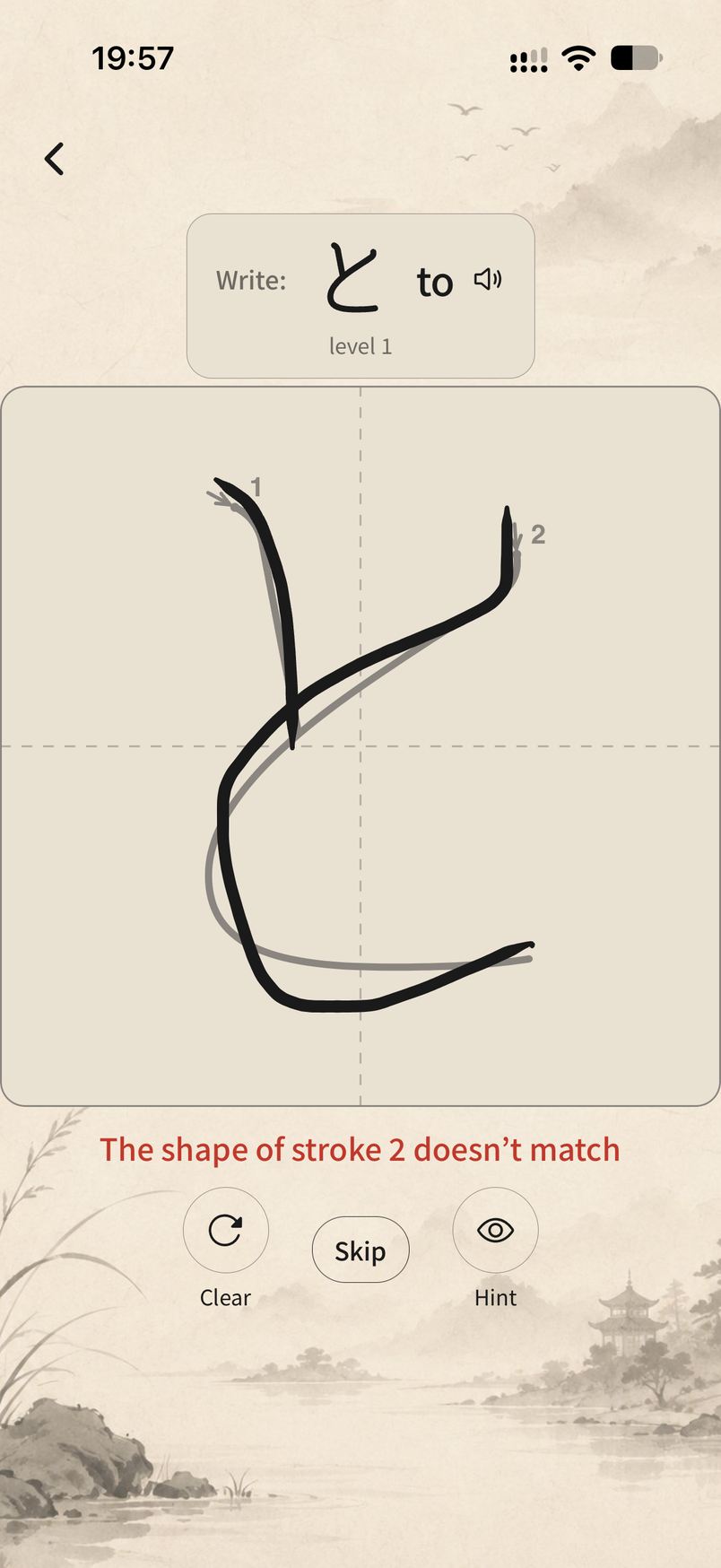
Write from memory, stroke by stroke
On a clear grid, with your finger — no stylus needed. The guide fades over six levels until nothing is shown, and every stroke is still checked.
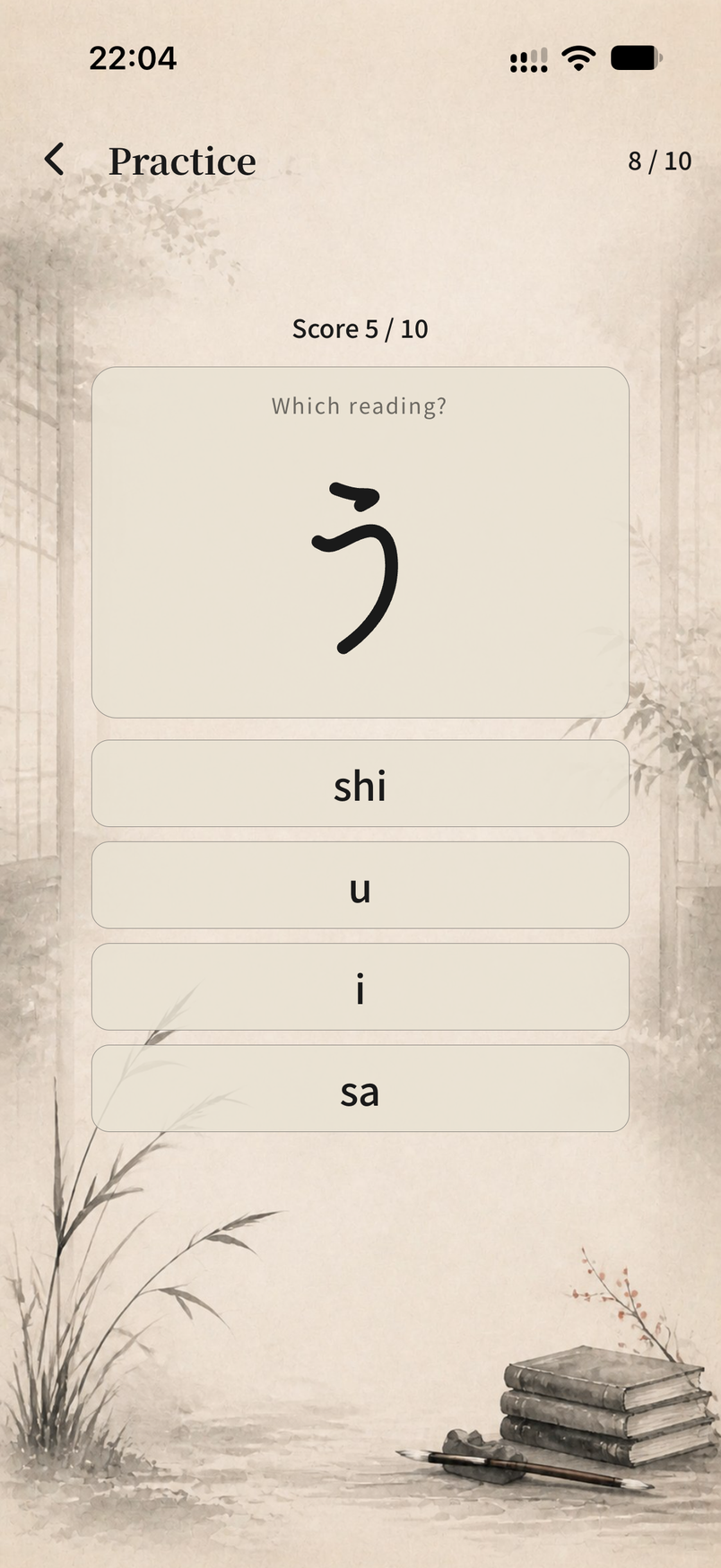
Read what you can write
Short Practice rounds built from the kana you've learned and the words you can already read.
PRACTICE
Write it. Then read it.
Five quiz modes — four for reading, one for listening — built only from what you already know: the kana you've learned and the words you can read. Rounds of up to ten questions, immediate feedback, and the pronunciation one tap away.
See a kana, choose how it reads.
Pick the right kana among look-alikes of the same script.
Read a whole word written in kana.
Find the word that matches the reading.
Hear a kana, pick the one you heard.
As you learn more kana, the questions follow. Practice is free on hiragana; FUDE Premium extends it across everything you learn.
VOCABULARY
56 words, unlocked by what you can read.
A library of 56 real Japanese words, written in hiragana, katakana, diacritics and yōon. Each word shows its kana spelling, its rōmaji and its meaning, and plays its Japanese pronunciation.
Words are not a separate course. A word becomes readable the moment every kana in it is learned — so the library fills up as your writing does.
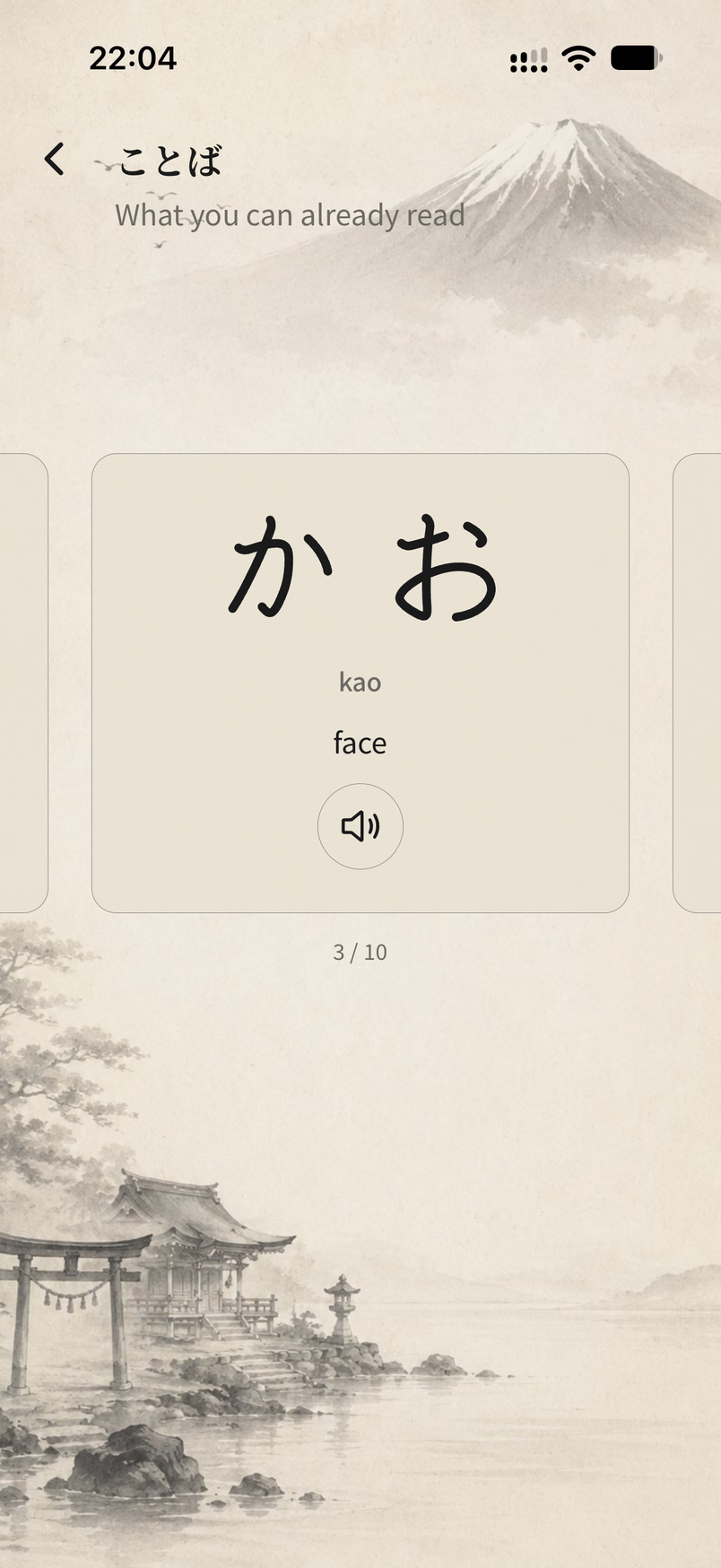
HANDWRITTEN FORM
183 written forms, in their handwritten shape.
Every form Fude teaches is one you write by hand, in authentic stroke order, with Japanese pronunciation audio.
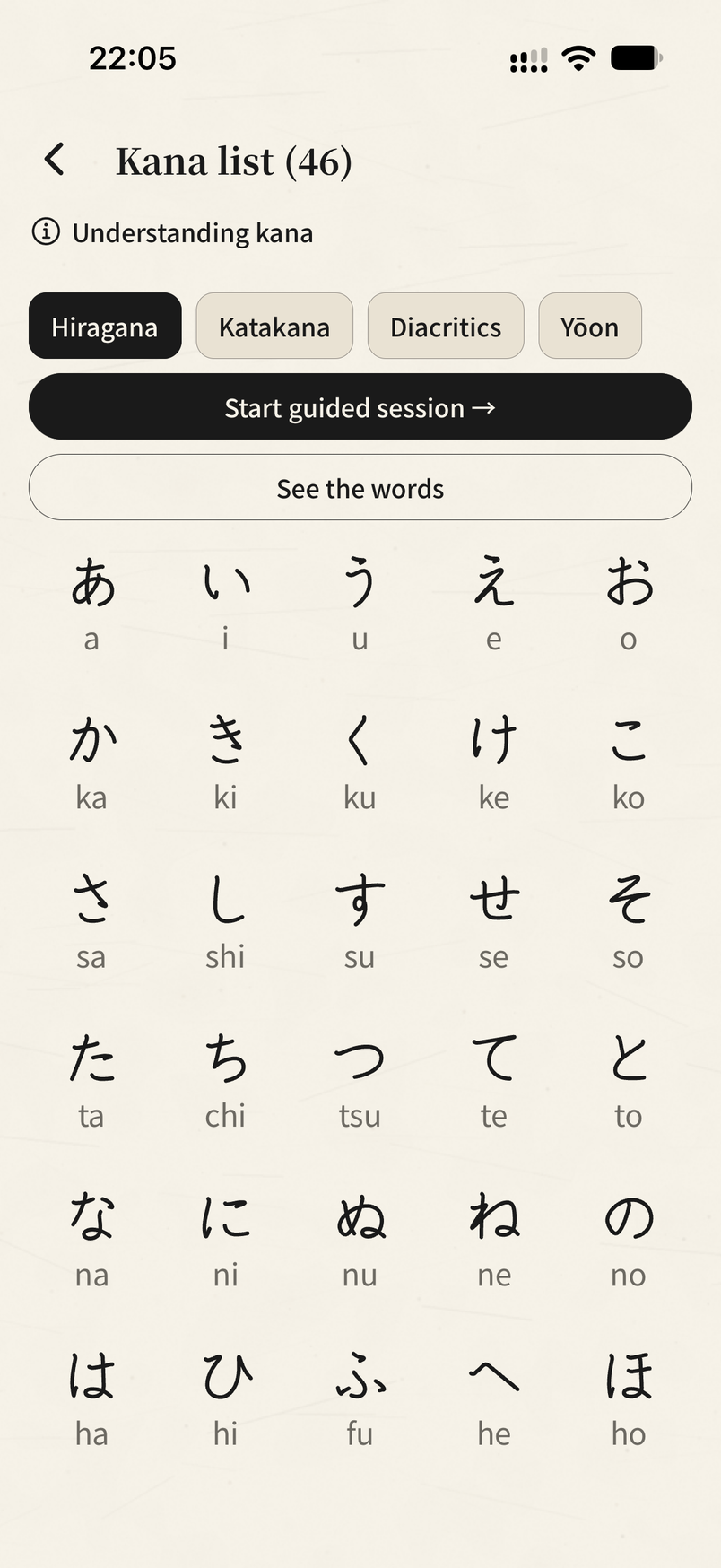
- 46 hiraganathe basic syllabary
- 46 katakanathe same sounds, second script
- 25 diacritics20 dakuten (か → が) and 5 handakuten (は → ぱ)
- 66 yōon forms33 sounds (きゃ, しゅ, ちょ…), each in hiragana and katakana
SIMPLE AND FAIR
Pricing
Free
183 forms to practise
Practise every one of the 183 written forms — full stroke-by-stroke recognition and pronunciation, katakana included. Plus the complete learning system for all 46 hiragana: guided sessions, fading guide, spaced review, progress, and Practice on what you've learned.
FUDE Premium
One-time purchase yours to keep
Guided sessions, fading guide and spaced review for katakana, diacritics and yōon — and Practice, for reading and listening, across your full kana and word library. No subscription, no ads, no account. The local price is shown in the app before purchase.
You never pay to find out whether the recognition works. Works offline. Your progress is stored on your device.
Frequently asked questions
Does Fude work with finger writing?
Yes. Fude is made for finger writing on the touchscreen — no stylus or Apple Pencil required.
What happens when a character is wrong?
Fude tells you which stroke, and why — for example "stroke 2 goes the wrong way" or "stroke 3 should be curved, not straight". It checks six things on every character: stroke count, stroke order, direction, shape, proportion and curvature. Most kana apps simply refuse the character without saying what went wrong, which leaves you repeating the same mistake.
Does Fude include reading and listening practice?
Yes. Practice is a short multiple-choice quiz with five modes — four for reading (Kana → rōmaji, Rōmaji → kana, Word → rōmaji and Rōmaji → word) and one for listening (Sound → kana) — built only from the kana you've learned and the words you can already read. You get immediate feedback and can play the pronunciation after each answer. Practice is free on hiragana; FUDE Premium extends it across katakana, diacritics and yōon.
How do words unlock?
Fude has a library of 56 Japanese words. A word becomes readable as soon as every kana in it is learned — there is nothing extra to study. Each word shows its kana spelling, its rōmaji, its meaning and plays its Japanese pronunciation.
What are diacritics and yōon?
Diacritics are the 25 forms made by adding a mark to a basic kana: 20 dakuten (か → が) and 5 handakuten (は → ぱ). Yōon are the 33 combined sounds such as きゃ, しゅ and ちょ, each written in hiragana and in katakana — 66 forms in all. Together with the 46 hiragana and 46 katakana, that makes 183 written forms.
Do I have to pay to practise katakana?
No. Every one of the 183 written forms — hiragana, katakana, diacritics and yōon — can be practised for free in study mode, with the full stroke-by-stroke recognition and pronunciation. What FUDE Premium extends is the learning system for katakana, diacritics and yōon: guided sessions, the guide that fades as you improve, spaced review, saved progress and Practice across them.
Is Fude free?
All of hiragana is free — all 46 characters, with the complete learning system, pronunciation, progress and Practice on what you've learned. Practising any other written form is free too. A single one-time purchase — FUDE Premium — extends the learning system and Practice to katakana, diacritics and yōon. No subscription, no ads, no account.
Does Fude sync between my iPhone and iPad?
No. Your progress is stored on the device you practise on, so each device keeps its own progress. There is no Fude account to create, and we never see your data.
Do I need to know any Japanese to start?
No. Fude starts from the very first hiragana character and teaches you to write from the ground up.
What is the best way to learn to write hiragana and katakana by hand?
The most effective approach is writing from memory rather than passive tracing, combined with feedback on each stroke. Fude is built around this: as the guide fades you write from recall, and its stroke-by-stroke recognition tells you why a stroke is wrong — such as wrong direction or a straight line where a curve belongs — so you actually learn to form each character correctly.
Does Fude collect personal data?
No personal information and no account. Progress is stored on your device and never reaches us. Anonymous, EU-hosted analytics stay off unless you turn them on; crash reporting is on by default and can be switched off in settings.
"When a character is wrong, Fude tells you why — instead of silently refusing it."
LEARNING GUIDES
Choose the right way to learn kana.
Clear guides for learners who want to read Japanese and form each character correctly by hand.